
For many people, goose, mulled wine and a Christmas tree are part of Christmas. With all three, the label decides how much “organic” is really inside. In this guide, you’ll learn how to recognise a goose that was raised in a species-appropriate way, what turns a mulled wine into an organic mulled wine, and where to get a Christmas tree grown without pesticides. You’ll also find a shopping checklist and tips for an organic Christmas on a small budget.
First things first: what “organic” guarantees at Christmas, and what it doesn’t
The same organic rules apply to goose, mulled wine and tree. Not every green label stands for a certified organic product, though.
The EU organic logo as the minimum standard
Every product sold in the EU as “organic” (“bio” or “öko”) must at least meet the requirements of the EU Organic Regulation, whether it’s a goose, a wine or a Christmas tree. Both terms and their variants are protected by law. Since January 2022, Regulation (EU) 2018/848 has applied. It sets out how farmers keep and feed their animals and which fertilisers and plant protection products they may use. On the packaging, you can recognise organic products by the green EU leaf and the control number. The number is made up of the country code, the word for “organic” in the national language and the number of the control body. In Germany, for example, it reads DE-ÖKO-001. Often the German hexagonal organic label is printed as well. It means the same as the EU logo: the product meets the requirements of the EU Organic Regulation.
Association labels: Bioland, Naturland, Demeter
If you want more than the legal minimum, go for products from an organic farming association. Bioland, Naturland and Demeter have stricter rules on animal husbandry, additives and fertilisation. Association farms, for example, must convert their entire farm to organic, while EU law allows organic and conventional production to run side by side on one farm under certain conditions. Our detailed organic label comparison shows which label comes out ahead on which criterion.
New since 27 September 2026: made-up labels are banned
Since the end of September, retailers are no longer allowed to use sustainability labels they have invented themselves. This helps especially during the Christmas shopping season, when green advertising claims are particularly common. With the EU EmpCo Directive now written into German competition law, sustainability labels are only allowed if they are based on an independently monitored certification scheme or were introduced by the state. Terms such as “natural”, “regional” or “Naturbaum” (“natural tree”), however, are still not protected. So rely on genuine labels. You can find out more in our guide “How to spot greenwashing”.

Organic goose: what to look for in your festive roast
An estimated 12.5 million geese are eaten in Germany every year, mainly at Christmas and on St. Martin’s Day on 11 November. How these animals lived varies enormously.
What sets an organic goose apart from a conventional one
An organic goose has access to the outdoors, receives organic feed and grows more slowly, which you can tell from the meat and the price. The EU Organic Regulation requires that organic poultry is regularly allowed outside. Waterfowl such as geese also need access to water, weather permitting. Farms must either keep slow-growing breeds or observe a minimum slaughter age, which is 140 days for geese. This makes the meat firmer and more flavourful. Conventional fattened geese often grow much faster and frequently live indoors. Geese from Poland or Hungary in particular often come from intensive farming without pasture.
Force-feeding and live plucking: the origin problem
A large share of the geese sold in Germany comes from abroad, where practices that are banned in Germany are allowed. Germany produces only around 14 to 19 per cent of its geese itself; more than four fifths are imported. According to the Federal Statistical Office, around 78.5 per cent of goose meat imports came from Poland in 2023, and a further 19.5 per cent from Hungary.
In France, Hungary, Bulgaria, Spain and Belgium, force-feeding for foie gras production is still permitted. Plucking live geese for down is banned in Germany but still widespread in China and Eastern Europe, for example in Hungary and Poland. On top of that there is so-called “Raufen”, where loose feathers are combed out during moulting. Whether this always happens at the right time is questionable.
Claims such as “no force-feeding” or “no live plucking” on the packaging are of little help to you, because they aren’t subject to any legal control. You have to take the producer’s word for it. The organic label is different: the EU Organic Regulation bans force-feeding and live plucking, and a state-approved control body inspects the farms regularly.
Reading labels and markings correctly in the shop
At the meat counter, look for two things: the EU organic logo or an association label, and the control number in the format DE-ÖKO-0xx, which tells you which body inspects the farm. Also check the country of origin. An organic goose from Germany is usually the safest choice, but an organic goose from abroad also meets the EU requirements. If there is no label and no indication of origin, be careful. The consumer advice centre of North Rhine-Westphalia (Verbraucherzentrale NRW) advises leaving goods from Bulgaria, France, Poland and Hungary on the shelf if they are not clearly labelled.
Ordering directly from the farm: it pays to be early
Organic geese from the producer are often sold out weeks in advance for St. Martin’s Day and Christmas, so reserve early. Many organic farms take orders as early as autumn and only slaughter shortly before the holidays. There you can ask directly how the animals lived, and you get fresh rather than frozen meat. It isn’t cheap: German free-range geese alone cost €18 to €22 per kilogram, imports from Hungary or Poland usually less than half that, and organic geese are often even more expensive. It’s better to plan for a smaller goose or an organic duck than to compromise on origin.
| Conventional (imported) | EU organic | Organic association (Bioland, Naturland, Demeter) | |
|---|---|---|---|
| Outdoor access | not required, often indoors | mandatory, access to water | mandatory, some stricter requirements |
| Feed | conventional | 100% organic feed | organic feed; associations require more feed from the farm itself or the region |
| Growth | often rapid fattening | slow-growing breeds or at least 140 days | as EU organic or stricter |
| Force-feeding / live plucking | permitted depending on country of origin | banned | banned |
| Inspection | no organic inspection | annually by an organic control body | additionally according to association guidelines |
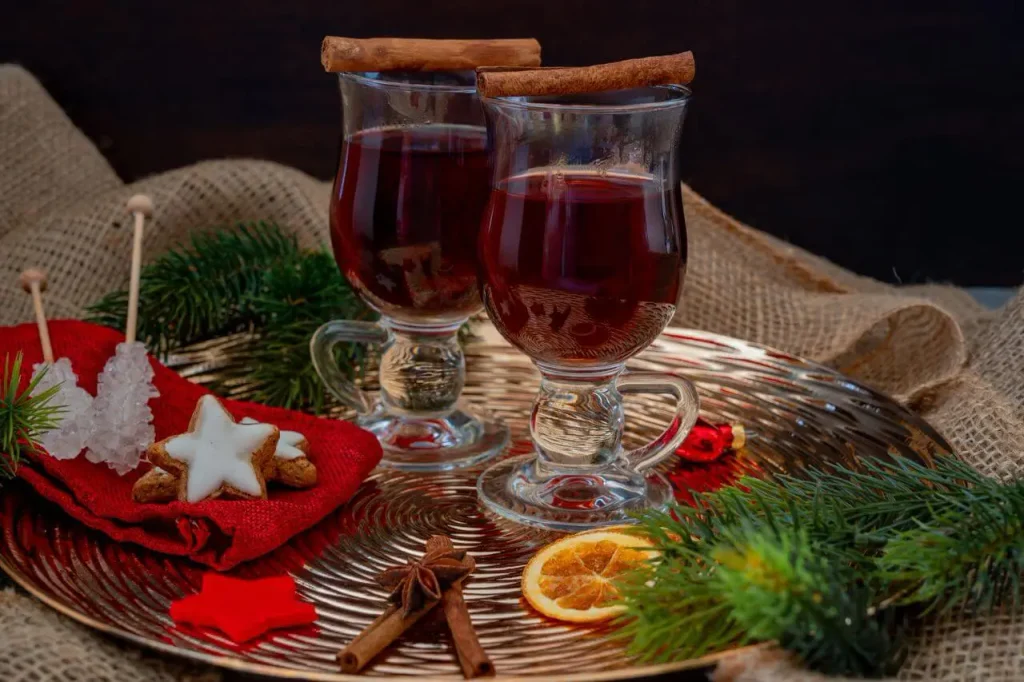
Organic mulled wine: what’s really in your mug
With mulled wine, it often remains unclear where the ingredients come from. The consumer magazine Öko-Test points this out, and it applies to the mug at the stall as much as to the bottle from the shop.
When a mulled wine may be called “organic”
Legally, mulled wine counts as an aromatised wine product. To carry the organic logo, at least 95 per cent of its agricultural ingredients must come from organic production. This applies to the wine as well as to the sugar and spices such as cinnamon, cloves and star anise. The grapes are then grown without chemical-synthetic pesticides, and the winery may use fewer additives.
The right labels: EU organic, Ecovin, Demeter, Naturland
There are only a few labels for wine, but they differ when it comes to sulphur and additives. Even the EU organic label limits sulphur more strictly than for conventional wine: for organic red wine, the maximum is 100 instead of 150 milligrams per litre. Ecovin, the association for organic winegrowing, as well as Demeter and Naturland, go even further in some cases and allow fewer processing aids. Supermarkets now also stock mulled wines with association labels, such as a white Bioland mulled wine. Several organic products also performed well in a mulled wine test by Öko-Test.
Vegan or not? The fining question
Even an organic mulled wine may have been clarified with animal-derived processing aids without this appearing on the label. Many wineries fine their wine with gelatine, isinglass (made from fish bladders) or egg white. These substances filter out cloudiness and barely remain in the wine, so they don’t have to appear on the ingredients list. If you’re vegan, look for an explicit vegan claim or the V-Label. Some producers now specifically advertise vegan organic mulled wine.
At the Christmas market: spotting organic stalls
A sign saying “organic mulled wine” is quickly put up. Only the certificate shows whether the stall is actually inspected. The EU Organic Regulation does not apply to out-of-home catering, so Germany has created its own rules: since 5 October 2023, the Organic Out-of-Home Catering Ordinance (Bio-AHVV) has provided a uniform framework for businesses that use organic food and advertise it. Anyone advertising organic products at a stall must register with the competent authority and be inspected by an organic control body. So feel free to ask for the certificate; reputable operators are happy to show it. If nobody can show you one, at best the wine is organic, but the mulled wine in your mug isn’t.
Children’s punch and alcohol-free alternatives
For children and drivers, there is organic punch made from juices and spices, where it’s worth checking the sugar content. Some wineries offer an alcohol-free organic fruit punch alongside red and white organic mulled wine. At home, punch is easy to make yourself: organic apple juice, organic grape juice, an orange and spices are all you need. That way you decide how sweet it is and know exactly what’s in it.
Organic Christmas tree: pesticide-free into your living room
According to the industry association, 23 to 25 million Christmas trees are sold in Germany every year, almost 80 per cent of them Nordmann firs. Organic trees make up only a tiny fraction of these.
Why the conventional tree is a problem
Most Christmas trees sold in Germany grow on plantations where herbicides, insecticides and mineral fertilisers are used. The environmental organisation Robin Wood also points this out. A tree like that then stands in your living room for weeks. The chemicals pollute soil, water and insects around the plantations, and the plantations often replace more species-rich land. According to the environmental association BUND, the environmental footprint of a real Christmas tree improves further if it is grown without pesticides and fertiliser.
Which labels count for trees, and which don’t
For Christmas trees, only organic labels guarantee cultivation without chemical-synthetic pesticides. Robin Wood recommends the labels of Naturland, Bioland, Demeter or Biokreis, as well as the EU organic label. FSC and PEFC are not organic labels; they certify forest management. An FSC tree therefore comes from a responsibly managed forest, which is good in principle, but it doesn’t come with a pesticide ban like organic does. Also be careful with names like “Naturbaum” (“natural tree”): according to Robin Wood, conventionally grown trees are sold under this name too. So look for the organic label.
Where to buy organic trees
Organic Christmas trees are still a niche. According to Robin Wood’s 2023 survey, they accounted for less than one per cent of the roughly 24 million Christmas trees sold, with 956 points of sale and 107 producers nationwide. The easiest way to find a seller near you is the environmental organisation’s online map at robinwood.de/weihnachtsbaum. Farm shops and some DIY stores also stock organic trees, and it’s worth calling an organic farm in your region too. Because supply is limited, it’s best to buy early, ideally in the first half of December.
Alternatives: potted tree, rental tree, regional tree
If you can’t find an organic tree, you have other options, and some of them are more sustainable than a bought tree. One is a tree in a pot. According to BUND, the blue spruce is particularly suitable because it can be dug up with its root ball and potted. Not every potted tree survives the holidays, however. How well it keeps growing depends partly on how long it stands in a warm room, because conifers are dormant in winter. So only keep it in the living room for a few days. With a rental tree, the provider collects it again after the holidays and replants it. And if it does end up being a conventional tree, at least choose one from your region: it saves transport, and you can ask the grower directly about pesticide use.
After the holidays: disposing of it properly
After Christmas, your tree doesn’t have to go in the general waste; most local councils collect and compost it. Remove decorations, tinsel and wire first so it can be composted or shredded cleanly. You can also cut it up and lay the branches over delicate beds in the garden as winter protection. With an organic tree, you can do this with a particularly clear conscience, because it hasn’t been treated with chemical-synthetic pesticides.
More organic classics for the festive table
Besides goose and mulled wine, organic is also worth it for other Christmas products, from baking ingredients to chocolate and nuts.
Baking ingredients and spices
For Christmas biscuits, you mainly need butter, eggs, flour and sugar. With butter and eggs, organic makes the biggest difference, because animal welfare is what counts here. It’s also better to buy spices such as cinnamon, vanilla and cloves in organic quality, as they usually come from tropical countries where conventional crops are often heavily sprayed. Organic vanilla is also guaranteed to be natural and not artificially flavoured.
Chocolate and cocoa: combining organic and Fairtrade
With chocolate, the organic label mainly protects the environment in the growing countries; it doesn’t guarantee fair wages. So combine organic with a Fairtrade label or Naturland Fair. That way you support organic farming and better conditions for cocoa farmers at the same time. This also applies to chocolate Father Christmases and Advent calendars.
Red cabbage, dumplings, chestnuts
You can get many classic side dishes for your goose regionally and in organic quality. Red cabbage, potatoes and apples are in season in winter and often come straight from an organic farm or the weekly market. Chestnuts and nuts, on the other hand, usually come from southern Europe. Here, the organic label tells you the products were grown without chemical-synthetic pesticides.
Organic Christmas on a small budget
An organic Christmas doesn’t have to be expensive if you set priorities and take a close look at retailers’ own brands.
Where organic makes the biggest difference: animal products first
On a limited budget, spend your money first on organic meat, eggs and dairy, because here the label directly determines how the animals were kept. With goose, the difference between the risk of force-feeding and inspected free-range farming is particularly large. Next come products that are heavily treated in conventional farming, such as spices, coffee or wine. You can save more easily on regional potatoes or cabbage. A smaller organic goose or an organic duck is often enough, especially if you use up the leftovers on the second day of Christmas.
Organic at discounters and drugstores: which label is behind it
Aldi, Lidl, Rewe, Edeka, dm and Rossmann have their own organic brands, often including mulled wine, baking ingredients and chocolate. All of them meet at least the EU standard. Some retailers also work with organic farming associations and stock selected products with the Bioland or Naturland label. So look closely at the packaging: does it only show the EU logo, or an association label as well? Our own-brand check shows you which label is behind which retailer brand.
Checklist: an organic Christmas at a glance
The key points for your shopping, to print out or save:
| Product | Minimum label | Stricter option | Typical pitfall |
|---|---|---|---|
| Goose | EU organic + DE-ÖKO number | Bioland, Naturland, Demeter, German origin | Imports without a label, unverified claims such as “no force-feeding” |
| Mulled wine (shop) | EU organic | Ecovin, Demeter, Naturland, Bioland | Animal-derived fining without a notice |
| Mulled wine (market) | Bio-AHVV certificate at the stall | Stall with association products | “Organic” sign without a certificate |
| Christmas tree | EU organic | Bioland, Naturland, Demeter, Biokreis | “Naturbaum”, FSC/PEFC confused with organic |
| Chocolate | EU organic | Organic + Fairtrade or Naturland Fair | Fairtrade without organic, or vice versa |
| Spices & baking ingredients | EU organic | Association products | Artificial vanilla flavouring |
Your Christmas with the right label
For an organic Christmas, all you need to do is look for the right label on your goose, mulled wine and tree. With goose, it protects you from force-feeding and live plucking, which can’t be ruled out with imports. With mulled wine, it guarantees grapes and spices grown without chemical-synthetic pesticides, but at the Christmas market only at a certified stall. And with the Christmas tree, it separates the pesticide-free tree from conventional plantation trees, while FSC and PEFC check something else. If you also order early, set priorities with your budget and look for association labels, you’ll celebrate a more sustainable Christmas.
Frequently asked questions (FAQ)
How much more expensive is an organic goose?
An organic goose costs considerably more than imported supermarket geese. German free-range geese alone cost €18 to €22 per kilogram, while imported geese from Hungary or Poland usually cost less than half that. Organic geese from the farm are often a bit more expensive still. In return, you get an animal that lived longer, could roam outdoors and was raised under inspection.
Does organic mulled wine give you less of a headache?
There is no solid evidence for this. Headaches after mulled wine mainly come from the alcohol and the sugar, especially as people often drink warm wine faster. Organic wine does contain less sulphur, but sulphites only cause problems for a few people. The best remedy is to drink in moderation and have some water in between.
Is an organic Christmas tree also better for children and pets?
An organic tree is grown without chemical-synthetic pesticides, so you bring fewer residues into your living room. That’s a plus if small children or pets nibble at the needles. Still, the same applies to every tree: needles and Christmas tree water don’t belong in children’s or animals’ stomachs.
Is a plastic tree more sustainable than a real one?
That depends on how long you use it. According to the German nature conservation association NABU, a plastic tree only has a better environmental footprint if you use it for at least 17 years, and many artificial trees don’t last that long. Other calculations arrive at shorter periods: a life cycle assessment for Swiss television found that after about five years of use, plastic and rental trees are comparable to plantation firs in terms of CO2 footprint. In most cases, a real organic tree from your region is therefore the better choice.
How do I spot a fake organic label?
Genuine organic products carry the EU organic logo with a control number, often supplemented by an association label. Made-up labels without independent inspection have been banned since 27 September 2026. You should still be wary of unprotected terms such as “natural”, “close to nature” or “regional”. Without a control number, a product is not a certified organic product.
This post is also available in Deutsch.